
A Sovereignty-Driven Space Economy May Be Rational — But Is It Sustainable
SPACE COMPANY & MARKET ANALYSIS
David Dong
4/15/20262 min read

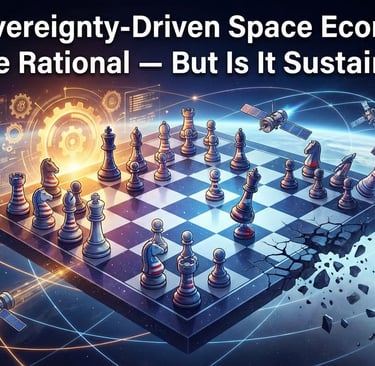
In space, the turn toward control is not hard to understand. States do not want to depend on foreign launch, foreign satellite infrastructure, foreign components, or foreign data in areas they consider strategic. From a security perspective, that is rational.
But strategic rationality does not automatically guarantee economic sustainability.
To see why, it helps to separate three questions:
1. Why a sovereignty-driven model works in the short term
A control-oriented model can create real advantages.
It can reduce vulnerability.
It can protect supply chains.
It can support long investment horizons.
And it can help build capabilities that markets alone might underprovide.
In a capital-intensive sector like space, that matters. Sovereignty can function as an economic organizer.
2. Why it can become costly over time
The same logic that produces resilience can also produce fragmentation. And fragmentation is expensive.
Launch systems are replicated.
Supply chains are reorganized around trust rather than efficiency.
Interoperability becomes harder.
Markets narrow.
Over time, that means:
higher redundancy costs
weaker gains from specialization
smaller benefits from market integration
The result is not necessarily stagnation. But it is a more expensive innovation system.
3. Why “more commercial” may not mean “more market-driven”
This is where the picture becomes more complicated.
On paper, space already looks highly commercial. Space Foundation’s latest reporting put the 2024 global space economy at $613 billion, with the commercial sector accounting for 78% of the total. SIA likewise reported that the commercial satellite industry accounted for 71% of the world’s space business in 2024, reaching $293 billion.
But that headline can mislead if we treat aggregate commercial share as proof that the sector’s underlying demand is now broadly market-led. It is not the same thing.
Those figures are useful because they show how large the commercial layer has become. But they do not, by themselves, show that the most strategic parts of the sector are sustained primarily by deep, autonomous private demand. That is a further inference from how these industry totals are constructed, not a direct conclusion from the topline numbers alone. Space Foundation’s own breakdown still assigns 22% of the 2024 global space economy to government budgets, which is a reminder that public demand remains structurally significant even in a sector that looks overwhelmingly commercial in aggregate.
So the real question is not just how many firms are private. It is: who the decisive customers are.
In many of the most consequential parts of space, the answer still points back to governments, militaries, public procurement systems, and state-backed priorities. Which is why the sector can become more commercial in form without becoming equally commercial in substance. That is an analytical judgment, but it is consistent with the broader pattern shown by current industry reporting: large aggregate commercial revenues can coexist with a strategically anchored demand structure.
And that distinction matters. Because a sector that looks commercial, but still depends heavily on strategic demand, is not sustained in the same way as an ordinary open market.
It may still grow. But that growth may depend less on broad autonomous demand than on the continued willingness of states to fund, protect, and structure the sector.
The real question
So the issue is not whether sovereignty matters. It does.
The question is whether the space sector can remain economically generative if it becomes more sovereign, more fragmented, and only partially commercial beneath the surface.
If space is becoming more commercial in form, is it also becoming more commercial in demand — or are state priorities still anchoring the sector more than we admit?
LU FRONTIER STRATEGIES
© 2024-2026 LU Frontier Strategies. All rights reserved.
