
China's Commercial Space IPO Bottleneck
SPACE COMPANY & MARKET ANALYSIS
David Dong
7/7/20263 min read
In August 2021, Rocket Lab went public. CEO Peter Beck said something that aged well: he didn't think it was going to take long for investors to distinguish between companies that are consistently delivering and those that are just hoping to get there."
Five years later, the market didn't just distinguish itself. It nearly wiped the board clean.
Of the seven most prominent US space companies that went public via SPAC in 2020–2021, six cratered. Astra: -99%. Momentus: -99%. Virgin Galactic: -98%. Rocket Lab? It's now worth ~$58 billion — 12x its IPO valuation.
One survivor out of seven. The rest erased over 98% of shareholder value.
What separated Rocket Lab from the dead?
Three things:
Proven technology before the IPO. Electron had 20+ orbital launches. 2019 revenue was 48M, 2020 hit 33M even through COVID. It wasn't a PowerPoint—it was a company that had already shipped.
Diversified revenue. Satellite components (reaction wheels, solar panels, and flight software) created recurring income decoupled from launch success rates. 2025 revenue reached $601.8M, up 38%.
Credible growth narrative. Announced Neutron to compete with Falcon 9 — and it was believable because the data from Electron already existed.
Now, rewind the lens to China.
As of July 2026, at least 10 Chinese commercial space companies are in various IPO application stages — LandSpace, CAS Space, MinoSpace, Galactic Energy, and others. Some have filed. Some are in review. Some are in tutoring. Not a single one has reached registration approval.
Meanwhile, capital keeps pouring in on the private side:
Chang Guang Satellite closed nearly ¥5B (~$680M) in equity financing on July 4, the second-largest deal in China's satellite sector
Hongqing raised over ¥1.3B (~$180M) in a Pre-B round on July 2, bringing cumulative funding above ¥2.5B
Money is flowing in. IPO approvals are not flowing out. That's a pressure cooker for early-stage investors who need an exit.
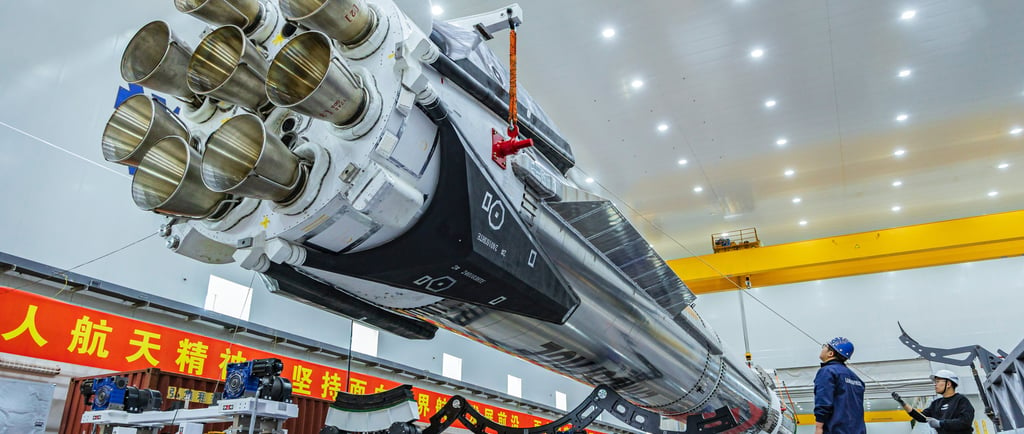
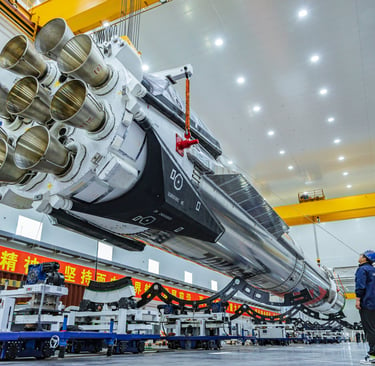
And here's where it gets specific: LandSpace's Zhuque-3 reusable rocket.
December 2025: first test flight. The second stage reached orbit successfully. The first stage recovery failed—at the final 40 meters. On June 29, 2026, the second test rocket completed full-engine static fire. The recovery attempt is now targeted for mid-July.
This isn't just an engineering milestone. It's a valuation signal for the entire sector.
If it sticks the landing: China has its first private reusable rocket. LandSpace's IPO story shifts from "almost there" to "proven." The domino effect would recalibrate how every other Chinese space company is valued.
If it doesn't: Not a company-killer — but the valuation anchor everyone is waiting for remains absent. And LandSpace is the lead horse. If the lead doesn't finish the race, what exactly anchors the valuations for the nine behind it?
The structural gap
The US let anyone with a SPAC and a slide deck go public. That killed six companies and billions in retail investor wealth — but it also gave early VCs their exit. The market cleaned itself up after the fact.
China is doing the opposite: pre-screening aggressively to protect retail investors. The cost? Early investors have poured in enormous capital (LandSpace alone raised over ¥10B before filing), and there's no clear path to getting it back.
That's not a "bad project" problem. It's not a "no capital" problem. It's a "how do I turn ownership into returns" problem. And it will define the next five years of commercial space investing in China.
What this means for investors
Private markets: Exit expectation management now matters more than valuation. For companies already in the queue (LandSpace, CAS Space, and MinoSpace), the question isn't "What are they worth?"—it"'s "When will the IPO actually open up, and is there an M&A path if it doesn't?" For earlier-stage companies, the longer exit horizon ironically makes current-round pricing less risky.
Public markets: Scarcity pricing is a double-edged sword. Rocket Lab's 12x return happened partly because it became the only independent publicly traded rocket company. If China approves 3–4 out of 10, a similar scarcity premium could emerge. But A-share market depth for pure-play space assets is untested, and SpaceX ($1.35T IPO) already anchors the global valuation ceiling—Chinese space companies will have to earn their multiples, not inherit them.
The real signal to watch: Not an IPO approval letter. A successful rocket landing. Because that one event doesn't answer "Can they list?"—it answers "What should they be worth?"
Zhuque-3's recovery window is open. Right now.
LU FRONTIER STRATEGIES
© 2024-2026 LU Frontier Strategies. All rights reserved.
