
Rocket Lab: What Is the Market Paying for at a $37B Valuation?
David Dong
7/27/20265 min read
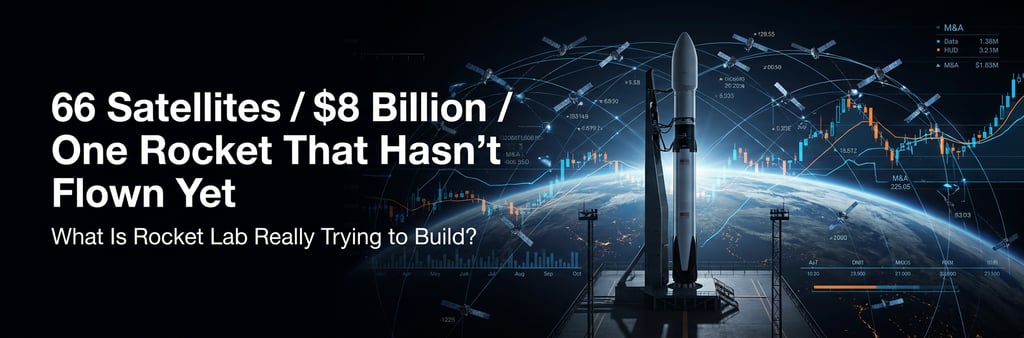
Rocket Lab (NASDAQ: RKLB) is one of the few listed space companies with a real launch track record, proven space systems capabilities, and credible platform expansion potential. But at $63.91, a lot of optimism already seems priced in.
1. After a 56% Drawdown, What Are Bulls and Bears Arguing About?
Rocket Lab has fallen 56% from its late-May all-time high of $150.23 and now trades at $63.91, implying a market cap of around $37 billion.
The bull case is straightforward: the fundamentals have not broken.
Q1 2026 revenue reached $200 million, up 63.5% year over year, a record high.
Adjusted EBITDA turned positive for the first time, at $13.7 million.
The backlog expanded from above $1 billion to $2.2 billion.
The U.S. Space Force awarded Rocket Lab a $266 million contract.
Wall Street’s consensus price target is $114, implying roughly 45% upside.
The bear case is equally simple: the stock is still expensive.
Rocket Lab trades at roughly 64x sales and 18x book value, versus an aerospace sector average near 3.8x sales.
Free cash flow over the last twelve months was negative by about $300 million.
Neutron has not flown yet, and the proposed $8 billion Iridium acquisition has not closed.
For a company that is still unprofitable, the $37 billion valuation looks hard to justify.
Our take: both sides have a point. That is exactly why a cautious, watchful stance makes sense here.
2. What Is the Market Buying at $37B? Three Scenarios
The key question is not whether the stock is “cheap” or “expensive” in isolation. The real question is, what exactly is the market pricing in?
At current levels, the valuation appears to assume two major things go right:
Neutron completes a successful first launch.
The Iridium acquisition closes and is consolidated into results.
Here is the scenario framework in plain text:
Bull case:
Assumption: Neutron launches successfully in Q4 2026, and Iridium is consolidated by mid-2027.
2027E revenue: about $1.6 billion.
Reasonable price-to-sales multiple: 25x.
Implied market cap: about $40 billion.
Upside versus current valuation: about +8%.
Base case:
Assumption: Neutron slips to Q1 2027, while Iridium closes on schedule.
2027E revenue: about $1.4 billion.
Reasonable price-to-sales multiple: 20x.
Implied market cap: about $28 billion.
Downside versus current valuation: about -24%.
Bear case:
Assumption: Neutron is delayed materially or fails on first flight, and Iridium faces regulatory or approval setbacks.
2027E revenue: about $1.0 billion.
Reasonable price-to-sales multiple: 12x.
Implied market cap: about $12 billion.
Downside versus current valuation: about -68%.
The message is pretty clear: in the optimistic case, upside is only about 8%, while in the pessimistic case, downside could reach 68%.
That does not mean Rocket Lab is a bad business. It means the current share price already reflects a very optimistic setup in which both major bets work out.
3. Bet One: Neutron — From Small Launch to a Bigger Story
Electron has already proven that Rocket Lab is not just a concept stock. With more than 60 launches, the company has demonstrated real execution capability.
But Electron remains a small launch vehicle, with a payload capacity of roughly 300 kg to LEO. That naturally limits the scale of the business.
Neutron is the true valuation unlock. With a planned payload capacity of 13 tons to LEO, it would push Rocket Lab into the medium-lift launch market.
Here is the competitive positioning in plain text:
SpaceX:
Main rocket: Falcon 9
LEO payload: 22.8 tons
Reusability: yes
Cumulative launches: 600+
Position: dominant industry leader
Rocket Lab:
Main rockets: Electron / Neutron
LEO payload: 0.3 tons / 13 tons
Reusability: Neutron is designed to be reusable
Cumulative launches: 60+
Position: leader in small launch, but medium-lift capability remains unproven
ULA:
Main rocket: Vulcan
LEO payload: 17.3 tons
Reusability: no
Cumulative launches: 10+
Position: important player in government launch
Blue Origin:
Main rocket: New Glenn
LEO payload: 45 tons
Reusability: partial
Cumulative launches: 1
Position: potential large-scale competitor
Neutron does not need to beat SpaceX. It only needs to become a credible second option for government and commercial customers.
But if the first flight is delayed or unsuccessful, the valuation framework could quickly fall back to a much simpler “Electron plus Space Systems” story.
4. Bet Two: Iridium — From Manufacturer to Operator
In June 2026, Rocket Lab announced a proposed $8 billion acquisition of Iridium Communications.
Why does this matter? Because it would fundamentally change the shape of the company.
Before the deal:
Revenue mix is roughly 40% launch and 50% space systems.
The business is still largely driven by one-time project revenue.
Gross margin was 38.2% in Q1 2026.
The company is primarily valued as a fast-growing aerospace hardware business.
After Iridium consolidation:
The business mix would include launch, manufacturing, and recurring satellite communications revenue.
Iridium would add more stable, recurring cash flow.
Iridium’s standalone gross margin is around 70%, which could improve the combined mix.
Rocket Lab would start looking less like a pure manufacturer and more like an infrastructure plus communications platform.
Iridium brings:
66 LEO satellites
L-band spectrum assets
A sticky government and commercial customer base
Recurring revenue and cash flow characteristics
If the deal closes smoothly, Rocket Lab would move from “selling rockets and components” to “selling rockets, components, and communications services.”
But execution risk is meaningful.
An $8 billion acquisition would likely require significant debt financing.
Running a satellite communications operator is very different from building rockets and spacecraft.
Regulatory approval, spectrum issues, and integration all add complexity and time.
5. Margin Improvement Is Real, but Free Cash Flow Still Needs to Prove Itself
The positive part of the story is real: Rocket Lab’s margins are improving.
Gross margin has expanded from 9% in FY2021 to 38.2% in Q1 2026, helped by a larger contribution from space systems, scale effects, and vertical integration.
Adjusted EBITDA turning positive suggests operating leverage is starting to emerge.
Here is the historical financial progression in plain text:
FY2021:
Revenue: $62 million
GAAP gross margin: 9%
Net loss: $94 million
FY2022:
Revenue: $211 million
Year-over-year growth: 240%
GAAP gross margin: 26%
Net loss: $183 million
FY2023:
Revenue: $280 million
Year-over-year growth: 33%
GAAP gross margin: 30%
Net loss: $182 million
FY2024:
Revenue: $436 million
Year-over-year growth: 56%
GAAP gross margin: 32%
Net loss: $191 million
FY2025:
Revenue: $602 million
Year-over-year growth: 38%
GAAP gross margin: 34%
Net loss: $198 million
Q1 2026:
Revenue: $200 million
Year-over-year growth: 63.5%
GAAP gross margin: 38.2%
Net loss: $45 million
However, free cash flow remains negative.
FY2025 free cash flow was about negative $500 million, with Neutron development and capacity expansion continuing to consume cash. Rocket Lab has not yet become self-funding, and the growth story still relies partly on continued access to capital.
If Neutron commercializes successfully and Iridium is consolidated on schedule, the cash flow profile could improve meaningfully. But until then, the valuation still runs ahead of current earnings and current cash generation.
6. What Should Investors Watch Next?
The next few milestones matter most:
August 6 earnings: can Rocket Lab deliver on the $225 million to $240 million revenue guidance, and will EBITDA momentum continue?
Neutron testing cadence: is the first launch still firmly on track for Q4 2026?
Iridium approval progress: is there visible movement on regulatory and spectrum-related approvals?
Space sector valuation anchor: if SpaceX’s public market valuation holds at very high multiples, that could continue supporting sentiment across the sector.
Free cash flow burn: Is the cash outflow narrowing or still expanding?
Rocket Lab is one of the most credible commercial space companies in public markets. But at a $37 billion valuation, investors are no longer just buying execution — they are paying in advance for multiple future successes.
That is why the stock may still work if everything goes right, but the margin of safety looks thin.
LU FRONTIER STRATEGIES
© 2026 LU Frontier Strategies. All rights reserved.