
The Slope Is Long: How ISU (and Others Like It) Have to Ski It Down
SPACE COMPANY & MARKET ANALYSIS
David Dong
7/11/20263 min read

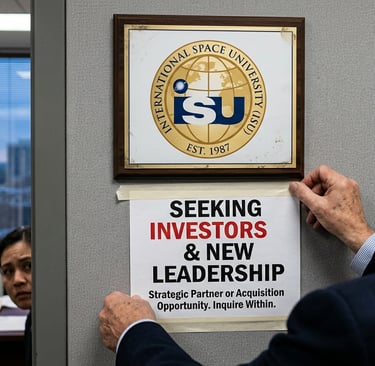
Same blueprint, published twice
In April 2025, ISU President John Wensveen unveiled "Moonshot 2030" at the 40th Space Symposium—a plan to build 6 regional satellite campuses worldwide, starting with Colorado Springs.
In July 2026, ISU's website quietly launched the "Global Campus Initiative"—partnering with top global institutions to build regional ISU hubs and affiliate campuses. The language is almost identical.
Timeline: → April 2025: Moonshot 2030 launches, with "revenue diversification" as a core goal → 2025: ISU appears on French judicial administrator CBF Associés' list of entities seeking recapitalization/buyers—officially entering financial restructuring → Early 2026: Wensveen publicly confirms CNES has fully withdrawn funding, ESA support is wavering, creating a €2.6M–3.4M revenue gap; ISU is absent from the 41st Space Symposium; qualified applicants are turned away for lack of scholarships
One detail stands out: when Moonshot 2030 launched in April 2025, "revenue diversification" was already the #1 priority. Making diversification the headline strategy is itself a signal—ISU already sensed the structural risk of relying on a single funder. Moonshot 2030 likely wasn't a pure growth plan. It was ISU looking for the next slope before the risk became public.
Then CNES pulled out. The thesis was confirmed.
The right prescription
The core shift in the Global Campus Initiative: ISU moves from "owning one campus" to "running a network." Partners provide space and local resources; ISU provides the brand, curriculum, and alumni network. Revenue shifts from tuition + government grants toward licensing + curriculum-sharing + executive education.
ISU's old model had three structural weaknesses: asset-heavy concentration on one campus, dependence on a single government funder, and tuition costs at odds with international recruitment goals. A distributed network directly targets all three: spreading infrastructure cost across regional partners, diversifying revenue across multiple nodes instead of one government, and unbundling the expensive immersive program into flexible modular offerings.
The direction is sound—this mirrors a decade-long shift across global education: from building campuses to building networks. ISU's brand, its alumni network (6,000+ people across 112 countries), and its 3I methodology (International, Intercultural, Interdisciplinary—now expanded to 4I with Innovation) are genuinely compounding assets. The problem was never the assets. It was the organizational form carrying them.
Space's specific challenge: the snowball rolls slowly, but the bills arrive fast
Space is a long-cycle industry. Launches take years to prepare. Constellations take a decade to deploy. Educational brands take generations to build. It's also a high-sensitivity industry—politically, technically, and financially. One policy shift, one geopolitical tremor, one funding withdrawal, and survival conditions change overnight.
That combination creates real tension: you need long-term investment to see returns, but your survival window can shrink suddenly.
ISU is living this tension right now. A global campus network is slow capital—talks with Portugal's Minho University started in April 2025 and still have no confirmed rollout. The gap between signing a partnership and generating tuition revenue is even longer. Meanwhile, ISU is facing an immediate €2.6M–3.4M shortfall.
This isn't unique to ISU. Commercial space companies face the same math: 3–5 year R&D cycles but funding windows that can close in six months. Constellations need a decade for global coverage, but spectrum licenses have deadlines. Space education needs several graduating cohorts to prove brand value, but tuition bills come due every semester.
In this sector, picking the right direction is only step one. The real test is whether your financial runway is long enough to let the snowball actually gather momentum.
Three nodes worth watching
The hardest part isn't choosing a direction or finding money—it's doing two seemingly contradictory things at once: commit to the hard, correct long-term path while staying flexible enough to survive short-term shocks.
1️⃣ Can the central campus hold steady? Strasbourg remains the brand anchor of the network. If academic output and enrollment quality slip during restructuring, the whole network's foundation weakens. Regional partners aren't buying a name — they're buying the credibility and alumni network behind it.
2️⃣ Can the first regional campus prove the model? Colorado Springs (with Space Foundation) is the pilot. Whether it generates revenue and attracts students within a reasonable timeframe will shape partner confidence going forward. Progress in Portugal and Hokkaido is also worth tracking—Asia-Pacific presence matters for ISU's international diversity.
3️⃣ Can financial restructuring and strategic transformation move in sync? ISU is running two tracks simultaneously: finding investors/buyers to solve the short-term cash crisis and executing the Global Campus Initiative to fix the long-term structure. If these two tracks reinforce each other — investors seeing "a transforming network platform" rather than "a shrinking legacy campus" — the odds of success rise sharply. If they diverge, restructuring pressure could end up dragging down the strategic pivot.
Bigger than ISU
ISU's situation is a microcosm of a broader question in the space sector: in a long-cycle, high-sensitivity industry, how do you make an organization's survival capacity match its strategy's payoff timeline?
Every institution making long-term bets in this space—commercial space companies, research institutions, and education platforms—faces the same test: the slope is long, and the snow is deep enough. But how far up the slope did you actually start?
ISU's Global Campus Initiative is a directionally sound answer. Whether it can be delivered in time is still an open question.
LU FRONTIER STRATEGIES
© 2024-2026 LU Frontier Strategies. All rights reserved.
