
Who Will Ultimately Pay for Space Collision Warnings?
SPACE COMPANY & MARKET ANALYSIS
David Dong
8/29/20263 min read

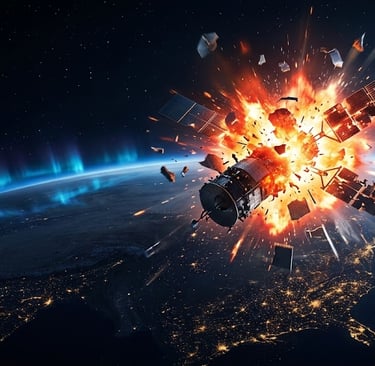
SpaceX’s free space safety platform now receives orbital data from more than 30 satellite operators and can typically return conjunction results within one minute.
Its Stargaze system uses nearly 30,000 star trackers aboard Starlink satellites as a distributed observation network, recording roughly 30 million object transits per day. The platform screens more than 500,000 ephemerides daily.
Under normal circumstances, this sounds like a service worth charging for. More satellites mean more congestion, greater collision risk, and stronger demand for reliable warnings.
But SpaceX is offering basic collision screening for free.
Does that undermine the commercial case for space situational awareness, or SSA?
Basic Safety Is Difficult to Monetize
Orbital safety is a shared interest. No operator wants to pay alone for a service that benefits everyone.
This is common with infrastructure built around public goods:
GPS signals are free, but they support a vast navigation economy.
Public weather data is free, but private companies sell forecasts, analytics, and decision tools.
Government orbital catalogs are free, but commercial providers sell higher-quality observations and intelligence.
The basic layer becomes infrastructure. Commercial value moves downstream.
Why SpaceX Is Giving Warnings Away
The operator with the most assets at risk has the strongest incentive to improve the system.
With more than 11,000 Starlink satellites in orbit, SpaceX faces collision risk as a daily operating concern. Its investment in observation, orbit determination, and conjunction screening primarily protects its own constellation.
Offering the service to other operators extends that protection.
If another satellite breaks apart, the debris still threatens Starlink. Improving safety across low Earth orbit therefore benefits SpaceX directly.
The platform also creates a network effect. Operators submit ephemerides and receive rapid conjunction results. As more operators participate, SpaceX gains access to more accurate orbital and maneuver data, potentially improving its own assessments.
It resembles crowdsourced traffic information: users contribute data and receive a better service in return.
Few drivers pay separately for traffic information. The business value appears later—in enterprise services, APIs, transactions, and operational decisions.
Free Alerts Are Not Free SSA
SpaceX is not making the entire SSA stack free.
The free layer includes ephemeris sharing, low-latency conjunction screening, a web interface, and operator API access.
It does not include everything required for high-value orbital intelligence, such as:
Raw observations and sensor data
A complete independent orbital catalog
Sensor calibration and algorithmic models
Detection and characterization of smaller objects
Precise orbit and covariance estimates
Cross-validation across multiple sources
Maneuver planning and decision support
Incident investigation and audit trails
This distinction matters.
Companies that simply repackage public catalog data may face growing pressure. Providers with independent sensors, differentiated data, and decision-support capabilities will remain valuable.
Customers are not paying only to know that a conjunction may occur. They are paying to decide whether to maneuver, when to act, how to coordinate, and who is responsible if something goes wrong.
Who Will Pay?
The most likely customers are:
Governments and defense organizations, for public safety, sovereignty and strategic awareness
Large satellite operators, for asset protection and automated maneuver decisions
Regulators and mission-control providers, for compliance and traffic coordination
Lenders and investors, for better visibility into operational risk
Insurers, for more accurate pricing and loss prevention
Investigators and legal parties, for evidence after incidents
Insurance deserves particular attention.
The space insurance market generates hundreds of millions of dollars in annual premiums, but much of the business remains concentrated around launch and early-orbit risks. In-orbit collision risk is difficult to price because historical data is limited, responsibility is often unclear, and reliable risk models remain scarce.
A validated SSA system could help turn collision risk into a more measurable variable.
If better monitoring and decision tools reduce expected losses, insurers could offer better terms to operators that adopt them. That would encourage more data sharing, improve actuarial models, and support more accurate pricing.
The result could be a feedback loop connecting orbital data, operational behavior, and insurance premiums.
But SpaceX Self-Insures
SpaceX largely chooses to retain Starlink’s in-orbit risk rather than buying extensive third-party coverage.
It can do so because it has:
A large constellation that distributes individual satellite losses
Detailed manufacturing and operational data
In-house spacecraft production and launch capabilities
The financial capacity to absorb and replace failed satellites
For SpaceX, self-insurance may be more economical than purchasing coverage.
New operators face different conditions. Smaller fleets cannot diversify losses as easily, while projects dependent on external financing may need insurance, guarantees, or other risk-transfer mechanisms.
Insurance is therefore not only about compensating losses. In commercial space, it can also make projects easier to finance by converting uncertain disasters into costs that lenders and investors can evaluate.
The operators most likely to pay may be new constellations, smaller satellite companies, and heavily financed projects—not SpaceX itself.
The Bill Has Not Disappeared
Basic collision warnings may struggle to become a high-margin standalone business. But that does not mean SSA has no commercial future.
The value is moving from alerts to:
Independent data
Better decisions
Automated action
Risk transparency
Regulatory compliance
Evidence and accountability
Operators will pay for maneuver decisions. Governments will pay for public safety and strategic capabilities. Lenders will pay for risk transparency. Insurers will pay for better pricing.
The alert may be free. Judgment, action, and accountability are not.
The collision-warning bill will not be paid by one party. It will be distributed across operating costs, government contracts, financing terms, regulatory compliance, and insurance premiums.
Who do you think will ultimately become the largest payer?
LU FRONTIER STRATEGIES
© 2024-2026 LU Frontier Strategies. All rights reserved.
