
Why Hong Kong Could Matter More in the Space Economy Than Many Assume
SPACE COMPANY & MARKET ANALYSIS
David Dong
4/10/20262 min read
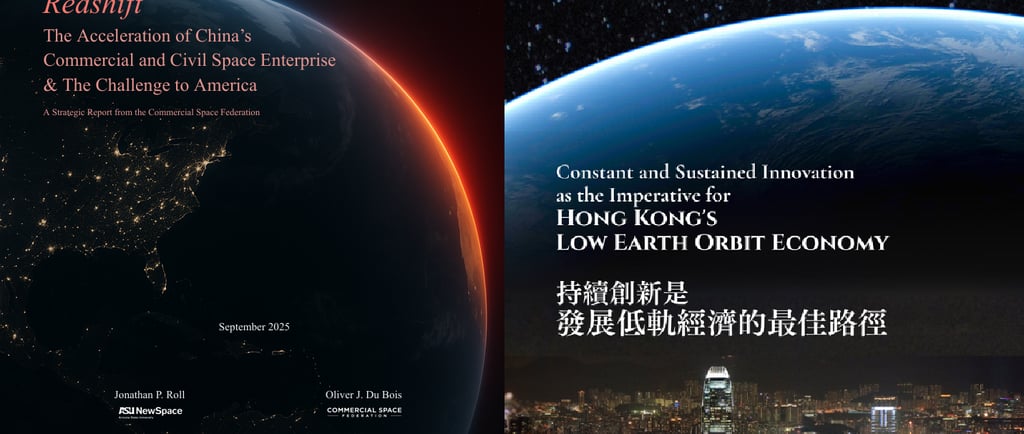
Two recent reports caught my attention.
One is American: Redshift: The Acceleration of China’s Commercial and Civil Space Enterprise & The Challenge to America, published by the Commercial Space Federation in 2025. It argues that China’s space sector is no longer just advancing through isolated state programs, but as a coordinated ecosystem spanning launch, infrastructure, remote sensing, satcom, commercial LEO, and deep space. ([commercialspace.org])
The other is from Hong Kong: Constant and Sustained Innovation as the Imperative for Hong Kong’s Low Earth Orbit Economy, published by the POD Research Institute in 2026. Its argument is very different, but equally important: Hong Kong should not try to compete in rockets or satellite manufacturing. It should focus on the downstream and institutional layers of the space economy—finance, law, arbitration, insurance, data governance, analytics, and international commercialization.
Read together, these reports point to a bigger reality:
Commercial space is no longer just a technology story. It is becoming an economic and institutional system.
That matters for Hong Kong.
For too long, space has been seen here as “someone else’s industry” because Hong Kong has no launch site, no rocket/satellite manufacturer, and no traditional space cluster. But that is the wrong lens.
The next phase of the space economy will not be defined only by who builds upstream hardware. It will also be defined by who can turn space capability into trusted, investable, insurable, contractable, and internationally usable business.
That is where Hong Kong can be relevant. The real opportunity lies in the middle layer of the value chain:
cross-border capital
common law contracting
arbitration
insurance and reinsurance
tax and transaction structuring
data governance
professional services coordination
international market access
The U.S. report, although written as a warning, reinforces the same point indirectly. What concerns American stakeholders is not just China’s technical progress, but the fact that China is building a broader space ecosystem—supported by policy, local governments, commercial firms, and international partnerships. That should be a wake-up call in Asia too.
Because when a space ecosystem reaches scale, it creates demand far beyond engineering:
legal structuring
financing
insurance
regulatory clarity
sector-specific applications
cross-border business development
Hong Kong should stop asking whether it can become a “space power.” It cannot, and it does not need to. The more useful question is this:
Can Hong Kong become a trusted node in the commercial space economy?
It surely can—but only if government, companies, and professional service providers approach this sector more seriously and more practically.
For government, that means treating commercial space as an economic and institutional opportunity, not just a technology theme.
For companies, it means thinking beyond hardware and focusing on real downstream use cases.
For universities and academic institutions, it means building cross-disciplinary platforms that connect space-related research with law, finance, data, policy, and commercialization — so that talent development keeps pace with industry needs.
For legal, tax, insurance, and financial professionals, it means building genuine sector fluency early, not waiting until the market is already mature.
Commercial space is becoming more global, more contested, and more cross-disciplinary. That creates pressure—but also openings.
Hong Kong’s role will not be won upstream. If it is won at all, it will be won through trust, structure, and cross-border execution.
Sources
Commercial Space Federation, Redshift: The Acceleration of China’s Commercial and Civil Space Enterprise & The Challenge to America (September 2025). ([commercialspace.org])
POD Research Institute, Constant and Sustained Innovation as the Imperative for Hong Kong’s Low Earth Orbit Economy (March 2026).
LU FRONTIER STRATEGIES
© 2024-2026 LU Frontier Strategies. All rights reserved.
