
Zhuque-3 Flies Again: Why a Rocket That Crashed May Be More Valuable Than a Perfect One
SPACE COMPANY & MARKET ANALYSIS
David Dong
8/17/20264 min read
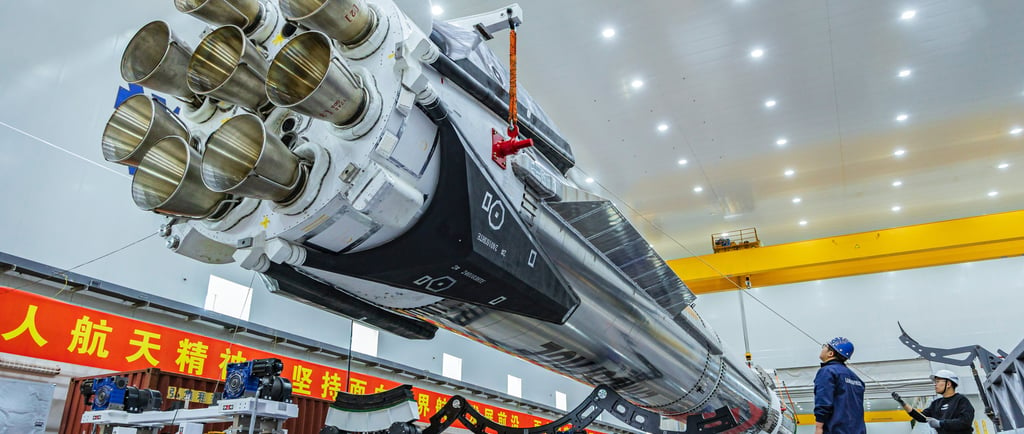
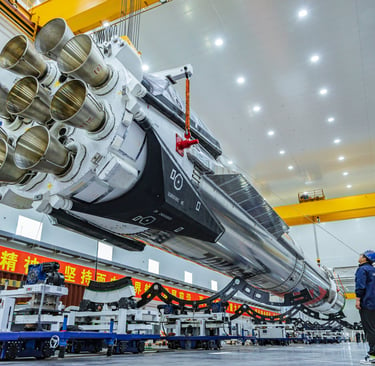
On December 3, 2025, Zhuque-3 successfully reached orbit—but failed to complete its first-stage landing.
In the final moments, flames engulfed the vehicle and smoke erupted across the landing pad. The official announcement was restrained: the second stage had entered its intended orbit, but the first-stage recovery test had not achieved the expected result.
To most people, those final seconds marked the difference between success and failure.
To engineers, however, the most valuable part of the mission may have been hidden inside that fireball.
Blueprints do not explode. Simulations do not produce smoke.
Only a real flight can reveal how aerodynamics, engine response, guidance algorithms, structural integrity, and control systems interact under extreme conditions.
Failure itself is not valuable. It becomes valuable only when it can be recorded, analyzed, reproduced, and corrected.
Otherwise, an explosion is simply an explosion.
But when a fireball becomes a dataset, an engineering iteration, and eventually a more reliable vehicle, failure has been converted into an asset.
A Rocket Test—and a Capital Market Test
On June 29, 2026, Zhuque-3’s second vehicle completed a full-system static-fire test. On the same day, LandSpace’s STAR Market IPO review returned to “inquiry received.”
The company is seeking to raise RMB 7.5 billion, with all proceeds intended for reusable-rocket technology and production capacity. (finance.eastmoney.com)
The timing is meaningful.
On one side is fire. On the other is capital.
One is testing whether a rocket can return. The other is testing how the market should value an unprofitable deep-tech company.
LandSpace lost approximately RMB 3.8 billion between 2023 and 2025. Its annual attributable net losses were RMB 1.188 billion, RMB 876 million, and RMB 1.711 billion, respectively. (finance.eastmoney.com)
Under a traditional industrial valuation model, this is a difficult financial story.
Revenue remains limited, losses remain substantial, and cash flow is under pressure. Yet LandSpace continues to invest in the industry’s hardest challenges:
Recovery
Reusability
Scaled manufacturing
High-frequency launches
This is not just a story about one company. It reflects a broader change in how commercial space is being understood and valued.
The Commercial-Space Narrative Is Changing
The article shared above, Technology Narrative Is Reshaping the Foundations of China’s Capital Market, makes an important argument:
Capital markets are gradually shifting their attention from how much a company earned in the past to how difficult a problem it may solve in the future.
Short-term profits and cash flow are no longer the only measures of value. Core technology, R&D intensity, and long-term industrial impact are becoming increasingly important parts of the valuation system. The article specifically identifies commercial space, AI, biotechnology, and quantum technology as emerging pillars of this new narrative. (stcn.com)
Put more directly, capital used to ask:
How much money are you making today?
Now it is also beginning to ask:
What problem are you solving? How difficult is it? And could solving it transform an entire industry?
For reusable rockets, the commercial model does not become real when one rocket reaches orbit.
The rocket must fly accurately, return safely, be inspected, be refueled, and be flown again. Only then can an expensive, single-use industrial product become a transportation system.
The profit from one launch is not the main story.
What capital is trying to price is the cost curve of the next 1,000—or 10,000—launches.
SpaceX Is the Extreme Version of the Same Story
SpaceX offers an extreme example of this changing valuation logic.
After its June 2026 IPO, the company ended its first trading day with a market capitalization of approximately USD 2.1 trillion—even though its filings disclosed continuing multibillion-dollar losses. (nasdaq.com)
Traditional earnings multiples cannot fully explain such a valuation.
The market is no longer pricing SpaceX simply as a rocket manufacturer.
Falcon, Starlink, Starship, orbital infrastructure, AI, and the longer-term possibility of a multiplanetary economy have been compressed into one valuation.
Its completed launches alone cannot support that price. Investors are buying a future that has not yet fully arrived.
Elon Musk has pushed this idea even further. He has suggested that advances in AI and robotics could make work optional within 10 to 20 years—and that money itself might eventually become less relevant. (fortune.com)
At first glance, this seems unrelated to reusable rockets.
In fact, both narratives point toward the same objective:
Using technology to break through scarcity.
If AI and robotics make labor abundant, the economic meaning of work and money may change.
If reusable rockets make access to orbit dramatically cheaper and more frequent, satellite internet, space manufacturing, orbital computing and deep-space development may move from science fiction into industry.
SpaceX’s extraordinary valuation, Musk’s post-scarcity vision and Zhuque-3’s pursuit of reusable launch are different chapters of the same story.
They are all bets on whether technology can turn a rare and expensive capability into widely available infrastructure.
But Not Every Loss Deserves a Deep-Tech Premium
This changing narrative requires an important warning.
Valuing technical difficulty does not mean valuing every loss-making company.
Allowing deep-tech companies to experiment does not mean allowing every business to use the words “deep tech” as an excuse for failure.
The article shared above makes the same distinction: Capital markets must support genuine innovation while guarding against companies that chase trends, promote concepts, and create valuation bubbles.
Real technological failure leaves behind:
Data
Patents
Products
Engineering capabilities
Measurable progress
Pseudo-innovation leaves behind press releases, concept images, and another fundraising deck.
The difference is concrete:
Did the rocket reach orbit? Did landing accuracy improve? Can the engine restart? Can the vehicle actually fly again? Is the cost per launch falling? Can orders become revenue?
Capital can tolerate failure.
It cannot tolerate failure without progress.
The Next Flight
Zhuque-3’s next flight must answer more than whether the rocket can remain standing after landing.
It must address a larger question:
Can China’s commercial space industry move from building individual rockets to operating a reusable space transportation system?
If it lands, it will validate months of engineering improvements and strengthen the industrial logic behind LandSpace’s fundraising plan.
If it does not, the team must identify the problem, improve the system, and fly again—with one condition:
The next attempt must move closer to the answer.
That is what makes deep technology compelling.
It does not ask failure for comfort.
It asks for failure for data.
A rocket may fall.
But engineering must keep moving forward.
Last time, Zhuque-3 left its answer on the landing pad.
This time, it is trying to bring the answer home.
LU FRONTIER STRATEGIES
© 2024-2026 LU Frontier Strategies. All rights reserved.
