
China Mobile’s Stake in Guodian Gaoke Is More Than an Investment—It’s a Turning Point for Satellite IoT
DILIGENCE & RISK REVIEW
David Dong
7/17/20266 min read
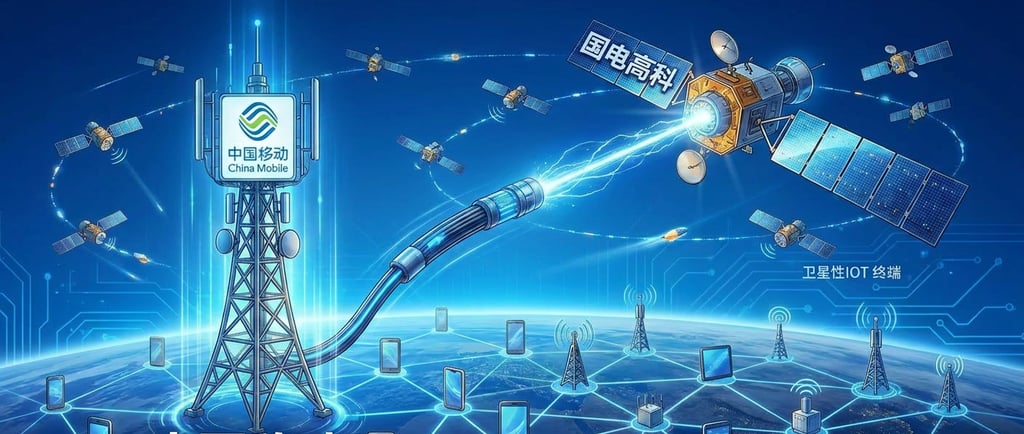
For months, the market had been expecting a move like this. On July 15, China Mobile, through its investment arm CMCC Capital, completed a strategic investment in satellite IoT operator Guodian Gaoke. After the deal, China Mobile holds 39.85% of the company, becoming its largest single shareholder, while founder Lü Qiang’s stake has fallen to 18.15%.
This is not an ordinary investment.
China Mobile is the world’s highest-revenue telecom operator. In 2025, its annual revenue surpassed RMB 1 trillion. CMCC Capital has invested more than RMB 210 billion across over 500 companies. China Mobile also has the technical foundation: a satellite communications research institute, direct-to-device satellite testing capabilities, and a 2,520-satellite low-earth-orbit constellation filing submitted to the ITU. It has the capital, the technical bench, and the industrial scale.
And yet, instead of building everything alone, it chose to buy.
That choice sends a signal much bigger than “China Mobile is entering satellite communications.” It suggests that the strategic value of satellite infrastructure within the future communications network has reached a critical threshold.
1. This deal is about buying time, not buying technology
To understand the significance of this transaction, we need to start with one simple fact: in satellite communications, China Mobile is still behind China Telecom.
China Telecom has a meaningful head start. It exclusively operates the Tiantong-1 high-orbit system, serves roughly 3 million Tiantong users, and launched direct-to-mobile satellite services as early as 2023. China Mobile, by contrast, is only in the early stages, with service rollout beginning much later.
On the ground, China Mobile is unmatched. It has the world’s largest base station network and more than 700 million 5G users. But in space, it is a challenger.
If China Mobile were to build a 2,520-satellite LEO constellation entirely from scratch, it would likely take at least three to five years from planning to deployment. Guodian Gaoke, however, already has 41 satellites in orbit, more than 100,000 connected terminals, and services in over 20 countries.
More importantly, Guodian Gaoke holds China’s only commercial trial license for satellite IoT services, issued by the Ministry of Industry and Information Technology in May 2025, with a two-year trial period. In practical terms, that makes it the only company currently allowed to legally operate satellite IoT services in China through May 2027.
So the core logic of this deal is clear: when the owner of the country’s largest terrestrial network chooses to acquire access to an existing network in space, it means satellite capability is no longer optional infrastructure. It is becoming strategically necessary.
2. The IPO path is not as wide open as many hoped
Why was China Mobile able to buy in now? Because the broader satellite sector is facing a difficult capital markets reality: the IPO route is far from guaranteed.
Take Yuanxin Satellite as an example. In 2025, it reportedly generated only RMB 188,700 in annual revenue—not RMB 188 million—while accumulating losses of RMB 2.2 billion over three years. It is the sole construction and operating entity behind the Qianfan constellation, which targets 15,000 satellites and already has 238 in orbit. Yet commercial revenue remains close to zero.
At the end of 2025, the Shanghai Stock Exchange introduced a more supportive listing framework for commercial rocket companies under the STAR Market’s fifth set of listing standards. But satellite operators have not been given the same treatment. Rocket companies may be able to list before profitability; satellite companies, at least for now, generally cannot.
That creates a stark reality for the sector: rocket companies may still have an IPO queue, but satellite operators are under pressure to either rapidly improve revenue and profitability or find another way out.
3. M&A exits are no longer theoretical
The Kuaizhou rocket case has already shown what that alternative can look like.
In January 2026, Aerospace Sanjiang listed 29.59% of Kuaizhou Rocket on the Beijing Equity Exchange. In April, Wuhan state-backed Wuchuang Xinghang Fund acquired the stake for RMB 3.299 billion, becoming the largest shareholder, while Aerospace Sanjiang ceased to be the controlling shareholder. One of the transaction’s hard conditions was the removal of the “CASIC” branding and the stripping away of central state-owned enterprise affiliation.
Kuaizhou Rocket went from being a subsidiary linked to a central SOE to becoming a market-oriented company controlled by local state capital.
This is one of the clearest public examples so far of a commercial space company achieving capital restructuring through a change of control rather than an IPO.
It demonstrates two things.
First, not every aerospace company has to go public. When the time cost, financing pressure, and uncertainty of an independent IPO become greater than the certainty offered by a strategic acquisition, M&A becomes a rational outcome.
Second, there is no single answer to the question of who the buyer will be. A strategic industry giant like China Mobile may buy an asset because it fits directly into its business architecture. A local state-backed fund may buy for a different reason: to anchor and cultivate a regional industrial cluster.
4. What kind of space company is actually worth acquiring?
There is no perfect formula, but the Guodian Gaoke case offers four hard criteria.
First, it must own real operating assets.
Guodian Gaoke has 41 satellites in orbit, over 100,000 terminals, and real paying customers. China Mobile did not buy a vision deck or a future narrative. It bought an operating business already generating revenue. As founder Lü Qiang put it, once the rocket launches and the satellite reaches orbit, the real business is only just beginning. After obtaining its license last year, the company reportedly began receiving orders in the thousands.
Second, it must have barriers that are hard to replicate.
Guodian Gaoke’s strengths are not easily rebuilt with capital alone: the only current trial license, an operational constellation, and valuable spectrum-orbit resources.
Licenses are scarce and tightly controlled. No one knows when the next one will be issued. Spectrum and orbital resources are also first-come, first-served. In December 2025, China submitted filings for 200,000 satellites to the ITU, and Guodian Gaoke accounted for more than 1,000 of them through the TIANQI-3F and TIANQI-3G constellations. Those filings help reserve strategic resources for the decade ahead.
Third, the target must be strategically complementary, not redundant.
China Mobile’s investment in Guodian Gaoke makes sense because the Tianqi constellation focuses on narrowband satellite IoT—connecting sensors, trackers, and industrial devices at kilobit-level bandwidth. China Mobile’s own 2,520-satellite filing is more likely aimed at satellite internet or broadband-style connectivity for handsets and broader communications access.
One is about connecting things. The other is about connecting people.
This is why the asset matters: China Mobile is not buying duplication. It is buying a capability it does not already have.
Fourth, the valuation must be digestible for the buyer.
The amount China Mobile paid for 39.85% of Guodian Gaoke has not been disclosed, but it is likely in the RMB billions. For China Mobile, that is manageable as a strategic allocation. By comparison, top-tier rocket companies with valuations above RMB 15 billion require buyers capable of writing much larger checks, and there are far fewer of those.
In other words, valuation defines whether a company is realistically IPO material—or a practical M&A target.
5. What does this mean for investors?
For the past several years, the dominant logic in China’s commercial space market has been straightforward: invest early, wait for an IPO, and exit.
But that path is increasingly crowded. More than a dozen companies are pushing toward listing, while review uncertainty, long queues, and market timing risks all consume time and investor patience. According to data from ITjuzi’s research arm, China’s commercial aerospace sector recorded 193 financing events between 2025 and Q1 2026, with disclosed funding totaling RMB 21.968 billion. All of that capital will eventually need an exit.
China Mobile’s investment offers a new model.
Once a company has crossed the “0 to 1” threshold in technology, built operating assets, established unique barriers, and remains reasonably valued, industrial M&A can become a more certain exit path than an IPO.
That is why the signaling effect here matters so much. The buyer is not a financial investor. It is one of the most powerful industrial players in the ecosystem. When the world’s largest telecom operator effectively says, “We need this capability,” it does more than validate Guodian Gaoke. It changes how the entire satellite IoT segment is seen.
For founders and investors in this sector, this may be the right moment to revisit a fundamental question:
Are you building an IPO story, or are you building an asset worth acquiring?
Sometimes, those are two very different strategies.
LU FRONTIER STRATEGIES
© 2024-2026 LU Frontier Strategies. All rights reserved.
