
If even ISU has reached this point, the issue may be bigger than one institution
SPACE COMPANY & MARKET ANALYSIS
David Dong
6/23/20263 min read
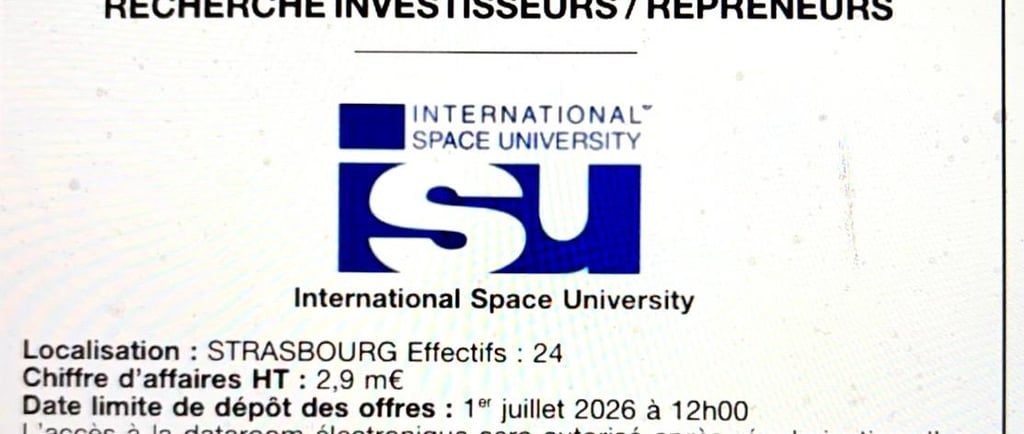
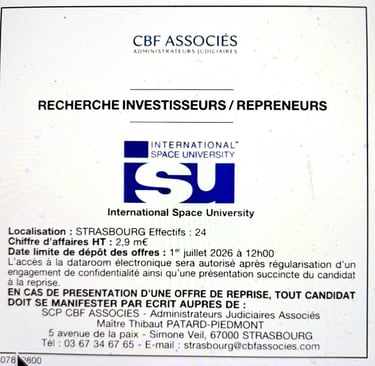
Intro: A recent notice from a French restructuring body has brought the International Space University (ISU) back into focus. For many people in the space community, ISU was never just another school. It represented a distinctive model of space education: international, interdisciplinary, and built around long-term networks across engineering, policy, business, law, science, and government.
That is why my first reaction was not simply that another institution is in financial trouble.
It was this:
If even ISU has reached this point, the issue may be bigger than one university.
ISU has appeared on the official investor/acquirer list managed through a French restructuring process. At the same time, ISU leadership has publicly acknowledged a major funding gap following the full withdrawal of CNES support and uncertainty over future ESA support. Reported estimates put that gap at roughly €2.6 million to €3.4 million.
To be precise, this does not automatically mean the campus itself is formally for sale. But it does mean the institution is under serious restructuring pressure.
And that matters because ISU’s value was never just academic delivery.
Since its founding in 1987, ISU has built a model around three rare assets:
international reach
interdisciplinary training
network effects
Its public profile points to more than 5,800 alumni across 112 countries. For a specialized institution of its size, that is a meaningful global footprint.
The challenge, in my view, is that the model behind institutions like ISU has become harder to sustain.
For years, that model depended on a familiar formula:
high tuition + scholarship support + global recruitment
Publicly listed tuition levels illustrate the problem:
SSP: around €20,000 including housing and meals
MSS: around €27,000
MSc: around €32,000
That structure can work when public or institutional funding helps support international access. It becomes much more fragile when those funding sources contract.
More broadly, this is not happening because space suddenly lacks money.
It is happening because space funding priorities have shifted.
Today, more capital and public support are flowing toward:
sovereign capability
defense and security
industrial policy
dual-use technology
and commercially measurable returns
By contrast, institutions like ISU embody a different logic: building a global space community, cross-disciplinary understanding, and international collaboration capacity.
Those things still matter. But they are harder to fund consistently.
AI adds another layer. It may not replace the most valuable parts of ISU — such as high-trust networks, cross-cultural teamwork, and career access — but it does reduce the premium on content-heavy, high-cost education.
Geopolitics adds yet another pressure point. Space is becoming more sensitive, more strategic, and in some cases less internationally open. That weakens part of the value proposition of institutions built around neutral, cross-border exchange.
There is also a lesson here for Hong Kong. If Hong Kong wants to grow as a space-related education and innovation hub, the takeaway may not be to replicate a heavy-asset, high-tuition international campus model. Its stronger position may be as a connector: linking mainland capabilities with international finance, law, commercialization, risk management, and Asia-Pacific collaboration. In that sense, the ISU case is not just a European story. It is also a useful stress test for how newer space education and talent platforms should be designed.
So to me, this is not just a story about one university in difficulty.
It is a signal that an older model of internationalist space education is under real strain.
The mission still matters. The model behind it is what looks increasingly fragile.
The bigger question now is what comes next.
My guess: future space education will need to be less dependent on a few public backers, less centered on expensive physical immersion alone, and more structured around platforms, networks, modular learning, and direct industry pathways.
ISU may be a specific case. But the lesson is much broader.
The next generation of space education will be defined not just by vision but by whether that vision can be matched with a sustainable institutional model.
Curious how others in the space, education, and policy communities see this.
LU FRONTIER STRATEGIES
© 2024-2026 LU Frontier Strategies. All rights reserved.
