
In complex environments, access is not the same as traction
In cross-border work, access is often mistaken for traction. In complex environments, that is where a lot of promising efforts quietly stall.
SPACE COMPANY & MARKET ANALYSIS
David Dong
5/12/20261 min read
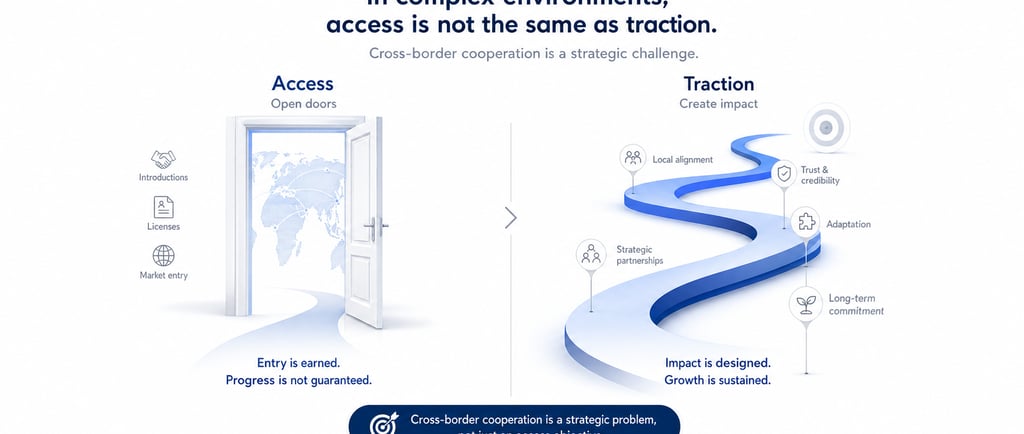
In cross-border work, access is often mistaken for traction.
A few meetings go well. There is visible interest. Credible people are willing to engage.
From the outside, that can look like momentum.
But in more complex, policy-sensitive, or China-related contexts, it often is not.
A lot of initiatives do not fail through explicit rejection.
They stall more quietly.
The conversations remain open, but do not deepen. Stakeholders are receptive, but no one really carries the work forward. There is enough interest to keep things alive, but not enough clarity or fit for real progress to form.
In those cases, the issue is often misread as a market problem.
But often it is a positioning problem.
The organisation may be relevant, but difficult to place. It may be speaking to the most visible stakeholders rather than the most consequential ones. Or it may be asking for a form of engagement that is out of sequence with how trust and credibility are actually built in that setting.
That is why I tend to think of cross-border advisory in complex sectors as more than a market entry exercise.
A meaningful part of the work is helping organisations become legible in the right way — so that engagement is not only opened, but can actually be understood, sponsored, and carried forward.
Access matters.
But in complex environments, it is not the same thing as traction.
#CrossBorderStrategy #StrategicPositioning #ChinaBusiness
LU FRONTIER STRATEGIES
© 2024-2026 LU Frontier Strategies. All rights reserved.
