
The Most Important Thing About SpaceX Is Where It Draws the Line
DILIGENCE & RISK REVIEW
David Dong
6/17/20264 min read
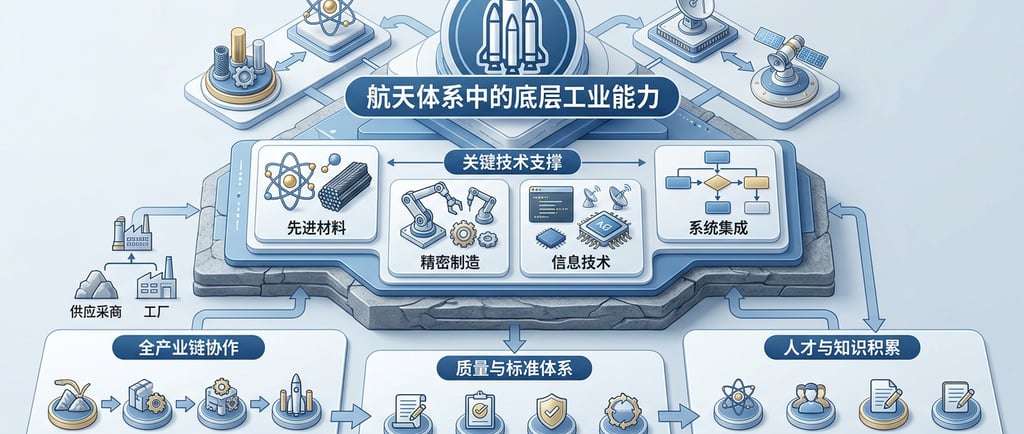
For years, the dominant way to describe SpaceX has been simple: vertical integration.
It builds its own rockets, engines, satellites, terminals, software, and launch operations. From the outside, it can look like a company trying to swallow the entire industrial stack.
And to a large extent, that’s true. SpaceX has publicly emphasized that much of its technology and products are developed and manufactured in-house. At the same time, it has also made clear that it relies on specialized, highly capable external suppliers.
That is where the real story begins.
SpaceX is not simply pursuing a philosophy of “do everything yourself.” What it is really doing is defining a moving boundary:
What is more efficient to source externally, and what is too strategically important to leave outside?
If you look at the company through that lens, a powerful industrial logic emerges:
SpaceX tends to leave outside those capabilities that are already mature, standardized, and well supported by supply chains in other industries. It tends to integrate those capabilities that are highly customized to its own system goals, tightly linked to performance and iteration speed, and not yet easily transferable to broader markets.
That is why, despite its reputation for full-stack integration, SpaceX still depends on third parties.
In its 2026 disclosure materials, the company explicitly stated that although its supply chain is “substantially vertically integrated,” it still relies on domestic and international third parties for certain critical materials, components, and services used in launch vehicles, spacecraft, satellites, and Starlink user terminals.
A good example is engine-related 3D printing capability.
It is easy to describe Velo3D as simply an outsourced 3D-printing vendor for SpaceX. But public disclosures suggest something more nuanced: Velo3D has long been an important source of metal additive manufacturing equipment and related technology for SpaceX. The company disclosed that SpaceX had been one of its largest customers, with revenue materially affected by SpaceX printer orders and shipment timing. In 2024, the two companies also entered into patent and technology licensing arrangements for SpaceX’s internal use.
That distinction matters.
What SpaceX truly wants to control is not necessarily every tool in the chain but the engine system itself, the overall design authority, manufacturing cadence, and the right to iterate on performance.
If advanced metal additive equipment and certain process platforms are already available from the outside world, then borrowing that infrastructure can be faster, cheaper, and strategically smarter than rebuilding it from scratch.
So the issue is not simply whether something is “core” or “non-core.”
The real question is
Does owning this capability improve speed, cost, and control enough to justify internalizing it?
In that sense, what SpaceX outsources is often not unimportant. Quite the opposite.
It often outsources capabilities for which other industries have already done much of the hard infrastructure work. When a technology is mature, standardized, and widely available, buying from the market can be far more efficient than recreating the stack internally.
But this boundary is not fixed.
The moment an apparently “generic” upstream capability starts to constrain SpaceX’s throughput, cost curve, performance ceiling, or supply security, it becomes a candidate for integration.
That is why SpaceX’s more recent moves deserve close attention.
Project documents made public in May 2026 indicate that SpaceX is advancing a semiconductor manufacturing initiative called "Terafab," with an initial investment of roughly $55 billion and potential total investment rising to $119 billion. Its 2026 disclosure materials also note that expansion at the Bastrop facility will add solar cell production capacity.
That is a striking development.
Semiconductors and solar cells would normally look like exactly the kind of upstream inputs a company could continue sourcing from external mature markets. But SpaceX appears to be reclassifying them as capabilities too important to leave outside.
Which points to a broader conclusion:
The real boundary at SpaceX is not between “general-purpose” and “custom” technologies. It is between bottlenecks and non-bottlenecks.
If a capability is mature, reliably available, and does not constrain system performance, then keeping it outside is rational.
But if it starts to determine whether SpaceX can scale faster, reduce cost further, or push performance higher, then even a seemingly generic capability can become strategically internal.
That leads to the more important question:
Will the capabilities SpaceX still leaves outside eventually be pulled in? And will the capabilities it has already pulled in one day begin to spill outward into other industries?
If the second part happens, the story changes completely.
Because space has always had a structural limitation: it is a relatively narrow market, with long development cycles, heavy validation burdens, and concentrated customers. Even very advanced technologies can remain trapped inside a small aerospace niche.
But if the capabilities SpaceX has built for extreme space applications begin to evolve into platforms that can serve broader industrial markets, then the ceiling rises dramatically.
At that point, SpaceX would matter not only as a stronger space company, but as something larger:
a technology originator that starts in space and then feeds back into the wider industrial economy.
That may be the real next chapter.
Not simply more rockets. Not simply more satellites.
But the spread of the underlying capabilities that space forced into existence: advanced manufacturing, upstream components, proprietary process technologies, and system-level cost-reduction methods.
If that happens, the most valuable part of commercial space may no longer be launching things into orbit.
It may be the industrial capabilities that were built in order to make those launches possible in the first place.
LU FRONTIER STRATEGIES
© 2024-2026 LU Frontier Strategies. All rights reserved.
