
What China’s “Net Recovery” Rocket Debut Really Means
DILIGENCE & RISK REVIEW
David Dong
7/13/20266 min read
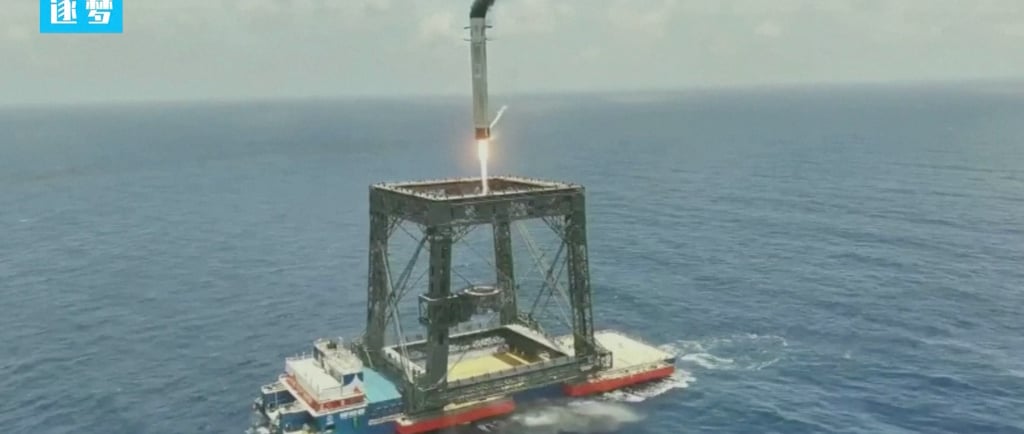

On July 10 at 12:15 p.m., the Long March 10B made its maiden flight from the Hainan Commercial Space Launch Site. Its first stage was reportedly recovered through a sea-based cable-net capture system—a striking milestone that quickly triggered bold headlines on Chinese social media, including claims that it had “completely beaten Falcon 9.”
That conclusion is too strong.
But dismissing the achievement as merely a “stopgap workaround” is also too simplistic.
The more useful question is this: What does this recovery method actually represent in technical, strategic, and economic terms?
This article looks at three issues:
How technically advanced is net recovery, really?
Why did China choose this path?
Will it actually reduce launch costs in a meaningful way?
Introduction
China’s latest reusable-launch milestone deserves a more serious interpretation than either online hype or reflexive skepticism.
The net recovery approach used by Long March 10B is not a clear “victory” over Falcon 9’s landing-leg architecture, but neither is it an engineering compromise devoid of innovation. It is better understood as a pragmatic systems-level solution shaped by China’s current launch geography, engine constraints, mission profile, and industrial timelines.
In other words, this is not just a different way to land a rocket. It is a different answer to the broader question of how to make reusability work under real-world national constraints.
1. Where Net Recovery Is Genuinely Advanced
The Long March 10B does not use landing legs like Falcon 9. Instead, it removes that hardware entirely and equips the booster with four lightweight hooks, allowing a dedicated recovery vessel to capture the descending stage with a large cable net.
That design has several real engineering advantages.
Lower mass penalty, higher payload retention
Landing legs add substantial dry mass. On a reusable booster, that mass becomes “dead weight” carried through ascent, directly reducing payload capability.
By replacing landing legs with much lighter hooks, the Long March 10B potentially reduces structural mass by a significant margin. In theory, that means:
smaller payload loss under recovery mode
better payload performance for the same vehicle size
improved economics for heavier-lift missions
This is especially relevant for 5-meter-class launch vehicles, where landing-leg systems become heavier and more structurally expensive.
Larger capture tolerance
A net-based capture system can tolerate a much wider landing dispersion than a hard touchdown onto a small droneship deck.
That matters because it changes the guidance problem. In simplified terms, it turns the endgame from something like precision pin-placement into controlled capture within a wider window.
That does not make the problem easy. It just shifts where the difficulty sits:
less dependence on ultra-fine terminal touchdown control
more dependence on vehicle-ship coordination
more dependence on relative navigation, timing, and dynamic capture mechanics
Softer structural loads
A flexible net can, at least in theory, reduce impact shock compared with rigid touchdown on legs.
If that translates into lower post-flight damage, it could eventually reduce:
inspection burden
refurbishment time
structural fatigue accumulation
That said, this point remains theoretical for now. One successful recovery is a milestone, but it is not yet proof of rapid turnaround or low-cost reuse.
2. Is This a Clever Innovation—or a Way Around Engine Limitations?
One of the sharper critiques circulating in Chinese commentary is that net recovery works partly because it avoids the need for extremely deep engine throttling during terminal descent.
That critique is not baseless.
Vertical propulsive landing with landing legs places very high demands on:
deep throttle capability
precise thrust control
very accurate terminal guidance
If an engine family has narrower throttling margins, then a recovery architecture with a larger capture tolerance can indeed reduce the burden on terminal control.
But calling that “dodging the real problem” is unfair.
Engineering is often about system-level optimization under constraints, not about solving every subproblem in the most elegant abstract way. If a vehicle, ship, guidance system, and capture mechanism can work together to recover the booster safely and reliably, that is not fake innovation. It is still innovation—just at the architecture level rather than purely the propulsion level.
So the balanced conclusion is this:
Yes, net recovery likely reduces the need for the most demanding terminal-landing precision.
Yes, that may partially reflect current engine constraints.
But no, that does not make the achievement trivial or “hollow.”
It is better seen as a practical engineering solution matched to available capabilities and operational realities.
3. Why Choose This Route?
There are at least three plausible reasons.
Launch geography
China’s coastal launch operations, especially from Wenchang/Hainan, naturally favor downrange ocean recovery.
A mobile sea-based recovery platform offers flexibility in choosing recovery zones while reducing risk to populated land areas.
Engine realities
If deep throttling remains more constrained on some engine families, then a wider-tolerance recovery architecture becomes especially attractive.
Suitability for larger boosters
For larger-diameter rockets, landing legs become more expensive in both mass and structural design.
That means net recovery may be especially appealing for heavier launch vehicles, where preserving payload matters more and the penalty of carrying legs becomes harder to ignore.
4. Will Landing Legs Still Matter? Absolutely.
This is not a story of one path replacing all others.
China appears to be pursuing multiple reusable-launch architectures in parallel:
Net recovery for large boosters such as Long March 10B
Landing-leg vertical recovery for other vehicles, including state-backed and commercial programs
potentially further evolution toward other capture or recovery concepts for future heavy-lift systems
That is a rational strategy.
Different rockets solve different market problems:
large launch vehicles may prioritize payload retention and heavy-lift efficiency
medium commercial launchers may prioritize operational flexibility and lower recovery infrastructure cost
So the real competition is not simply “net vs legs.” It is which configuration works best for which mission class.
5. Is This a Temporary Detour—or a Useful Long-Term Path?
A common criticism is that if net recovery proves hard to scale, then the money spent on specialized ships and capture systems may end up wasted.
That concern is understandable, but probably overstated.
Why? Because most of the difficult reusable-launch technologies are shared across recovery methods:
reentry guidance
attitude control
engine relight
propellant management
thermal protection
aerodynamic control with grid fins
high-dynamic navigation and control
Those are the expensive, difficult capabilities. And they remain valuable even if a program later shifts from one recovery architecture to another.
In aerospace, even “dead ends” often become stepping stones.
Many breakthrough systems are built on earlier demonstrators that never became final operational solutions. So even if net recovery eventually turns out to be best suited only for a certain class of rockets, the technical investment behind it is still highly reusable.
6. The Cost Question: Promising, but Far from Proven
This is where the conversation needs the most caution.
Today, all Chinese cost-reduction figures tied to Long March 10B reusability are still theoretical. They are based on modeling, industry estimates, and analogies—not on repeated operational reuse.
That distinction matters.
What Falcon 9 proved
Falcon 9 is still the only system with deep real-world evidence for reusable-launch economics:
many hundreds of recoveries
very high booster reuse counts
years of operational learning
demonstrated reductions in marginal launch cost
Its key lesson is that cost savings do not come simply from dividing manufacturing cost by the number of flights. Reusability only works economically if several conditions are met:
refurbishment is cheap enough
turnaround is fast enough
launch cadence is high enough
recovery operations are reliable enough
The hidden costs of net recovery
For Long March 10B, at least three unresolved cost items could materially affect the final economics.
1. Specialized recovery ship cost
A dedicated recovery vessel with dynamic positioning, support structures, damping systems, and capture equipment is a major capital asset.
That cost must be amortized across enough missions to make the model work.
2. Turnaround efficiency
Even after successful net capture, the booster must still be:
secured at sea
transported back to port
moved to refurbishment facilities
inspected and prepared for reflights
Until repeated reflights happen, claims about very fast turnaround remain design goals, not operational fact.
3. Weather and sea-state constraints
Sea recovery depends heavily on maritime conditions.
If launch schedules and recovery windows do not align, operators may eventually face uncomfortable tradeoffs:
delay the mission to preserve recovery
or fly on schedule and sacrifice the stage
That could reduce the real economic benefit.
7. So What Is the Most Defensible Bottom-Line View?
If the question is whether Long March 10B’s net recovery is technically meaningful, the answer is yes.
If the question is whether it has already surpassed Falcon 9, the answer is no.
If the question is whether it is merely a desperate workaround, the answer is also no.
The most defensible interpretation is this:
Net recovery is a credible, pragmatic, and potentially valuable reusable-launch architecture—especially for larger boosters—but its long-term superiority has not yet been proven.
It offers real advantages:
lower onboard recovery mass
potentially better payload retention
wider terminal capture tolerance
possibly lower structural impact
But it also has real uncertainties:
specialized infrastructure cost
sea-state dependence
scaling challenges
lack of demonstrated rapid reuse
8. Why This Matters Beyond One Rocket
The strategic significance may be bigger than the single recovery event itself.
China’s launch sector is operating under a different set of constraints than SpaceX did in its early reusable era:
limited tolerance for repeated high-profile failures
urgent constellation deployment timelines
the need for domestic supply-chain maturity
simultaneous pressure to improve both reliability and cadence
Under those conditions, pursuing multiple recovery paths in parallel is not wasteful duplication. It is a form of risk hedging.
If one route takes longer than expected, another may still reach operational usefulness in time.
That may be the most important lesson here: the goal is not ideological purity about one recovery method. The goal is to get reusable launch working at scale.
Conclusion
The strongest claim is not that Long March 10B has “beaten Falcon 9.”
It is that China has demonstrated a serious alternative approach to first-stage recovery, one that reflects its own engineering tradeoffs rather than copying another company’s playbook outright.
For now, the right stance is respect without exaggeration.
This was a real milestone. It was not final proof. And the economic story has barely begun.
LU FRONTIER STRATEGIES
© 2024-2026 LU Frontier Strategies. All rights reserved.
